Genspark AI Workspace Literally Does Everything and It Feels Like Magic
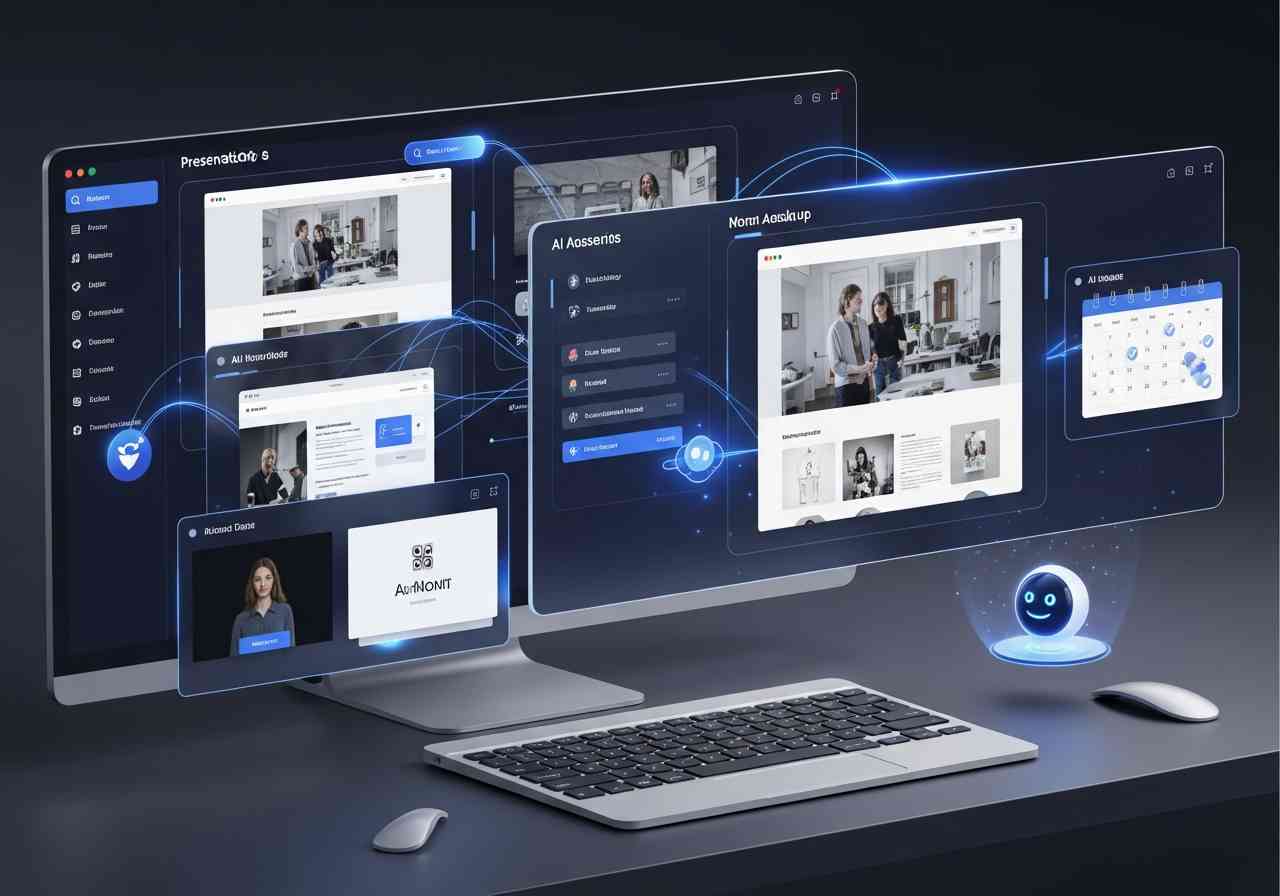
It has a new all-in-one Genspark AI workspace that has been developed to prevent tab hopping, stitch models and tools in one place, and provides finished work that can be handed directly to a client or simply dropped into operations. It clogs headline models, spins agents who really go to work on your behalf, and delivers finished work – slides, websites, brand packages, calls, transcripts and recurring reports – all under one roof.
Why one workspace matters
The majority of us work with dozens of interfaces: a brainstorming chat model, a visual design app, a slides presentation app, and other tools that are used to do repetitive tasks separately. This workspace turns this model upside down. Rather than transferring data between applications, it coordinates models and tools simultaneously to achieve the brief-to-deliver without tending to each step.
A single workspace that coordinates various AI models and the tools that envelop them to ensure that you get to work in a single location rather than tab hopping.
The platform is based on multi-agent flows: multiple models will be used simultaneously, the system will auto-prompt on your vague request, reflect to outputs, select the best path, and execute using the appropriate tool. The outcome is less ideation and more like delegating a task and leaving it to an assistant to complete on your behalf.
What is in the middle: Inbox and Teams
AI Inbox is an email organizer that processes messy mail-piles and performs the tedious, yet vital task in a moment. It condenses the lengthy strings, proposed responses in your style, turns choices into slides and can be managed either using text or real-time voice. It even allows you to set agents to check the updates, package changes, remind you about deadlines and automatically ship drafts.
The actual payoff is made up of smooth handoffs. The content exits straight into the slides, documents, and other products without export ball. When it goes underwater that handoff is the distinction between plan and promise.
Team includes collaborative work on projects, simultaneous editing of slides, sheets, documents, and designs, as well as an AI assistant within the file. This is not just a chatbot co-located and beside a document. The assistant resides on the canvas: drop a brief on one slide and the model reformulates the next slide on context as you work on the layout. Agents are combined with permissions, real time presence and versioning that do not merely propose their text but act.
Important tools which literally generate outputs
AI Slides
Give the system a file, outline or even an ugly PDF and it will create a structured deck with one of 100+ templates. You have sectioning, regular type usage, intelligent positioning of graphics and feature first pass charts that do not look like an unrefined spreadsheet output. The importation and exportation assistance apply to PPTX, PDF, and Google Slides thus teams are not confined.
Last-mile edits, which also involve choosing an area, explaining the change, and letting the model apply to it, are also managed by the editor. The slide which is a pull statistic is subject to a quick fact-check pass so that the hallucinated numbers do not affect the trust of clients.
AI Developer
Explain a location or application using non-technical language and the platform scaffolds a working application you can deploy. Click the hint to a preexisting web address to be visually inspired by the layout and the agent trains on layout, spacing, navigation, and more and creates your own. Its workflow is speed oriented: Its landing pages and internal dashboards can be published with minimal touch-ups.
AI Designer
Order one sentence, one reference image and receive a complete brand kit: logos, packaging mockups, posters, social materials, illustrations, and photo-real product composites. The system drives various variations forward and allows you to work directly on the canvas. When you only need to do a little rebranding or even a sprint project, you can create a whole visual language in an afternoon since feedback loops are real-time.
Specialized Real World Agents
- Call For Me: makes outbound calls in your behalf, records transcripts, and broadcasts summaries. Helpful in making a reservation, checking the stock in haste, or writing outreach scripts. The voice and the speed can be chosen and the agent identifies itself as an AI assistant as a display of ethical transparency.
- Download For Me: processes bulk grabbing of assets on scattered sources.
- AIPOD: rotates series audio content of a subject in the form of a podcast and sends it by a similar template.
- AI Image and Video: swipe through the most popular models and change engines with various visual or motion effects without leaving your documents or slides without any handoffs.
Super Agents and Super Agent Store
In case of repeatable workflows, the platform has suggested a system of super agent. Write a description of an assistant once, e.g., to write a weekly report on the industry, or to gather stock data daily, or to assist in a research project, have the platform build the agent architecture, select models, place tools, and configure routines.
Super agents may be reused within the workspace, called by name, and shared to a store where others may execute the same automation. This significantly saves the time between idea and a reliable assistant that is predictable to give deliverables on schedule.
Pricing, models, and rollout
Pricing is centered around one subscription model: a free credit pool upfront and then a subscription of around $19.99 per month which gets the full set of features and various models. Its platform works with the major model families, such as GPT, Claude, Video-only Veo, and Image-only Nano Banana, and so you do not need to pay four similar tools.
It is not flawless. Slide drafts must be human polished and the early voice agents may fall slightly behind. But those are normal trade-offs at the initial development stage of speed and automation. Get conscious of what information you relate to the platform through email or drive.
Why this direction matters
We are shifting toward the solitary AI assistants to the combined work environment where the models, agents, and collaboration coexist. That matters because:
- Automation can be implemented: agents not only make suggestions but also ship the deliverables.
- Groups can remember history: AI does not coexist with files.
- Standardization of work Repeatable work is made reusable: super agents standardize recurrent work.
- Speed takes the place of friction: hours of handoff between inbox and deck, as well as one-click publishing, are spared by speed.
When to try it
The inbox and teams features are the first to be tried by those who live in email, decks, and collaborative documents. The two elements mentioned above open the majority of the workflow victories: filtering the inbox, organizing a narrative, filling the image, and keeping an agent drag the project along. When those are operating, visit slides, designer, developer, and the super agent store to learn more about automation.
Final thoughts
This type of product is not related so much to glossy single-time demonstrations but rather to automation that can save hours. The actual money is represented when email is transformed into a workable deck, a brief is turned into a site on which you can post what you have published, and a weekly report is delivered by an agent with whom you need have barely a touch.
Is this the future of AI work-based methods? It definitely takes this direction: models, agents, and teamwork in the same place. In case the work depends on decks, or docs, or fast launches then it is worth considering this approach.